Be yourself; Everyone else is already taken.
— Oscar Wilde.
This is the first post on my new blog. I’m just getting this new blog going, so stay tuned for more. Subscribe below to get notified when I post new updates.
Be yourself; Everyone else is already taken.
— Oscar Wilde.
This is the first post on my new blog. I’m just getting this new blog going, so stay tuned for more. Subscribe below to get notified when I post new updates.
Food’s Role
While I studied abroad in Italy during the January Venice Session in 2019, I took a course on the Aesthetics of Food Culture. During this course, we discovered the role that food plays during interactions with family and friends through analyzing film and different narratives. All throughout history, food is able to bring people together despite the circumstance. It’s used as a conversation and a way for people to bond. There are little nuances I never knew about regarding foods we claim to be “Italian” in America that are altered and not genuine to the real Italian culture. Spaghetti and meatballs are never paired together in Italy, but we combine the two in one dish in America.
Food can evoke a sense of nostalgia and bring back memories we connect with each dish. I used to love walking into my grandparents’ house because it would always smell like freshly cooked rice and an assortment of Filipino dishes which meant we would be laughing and talking all night.
The Shift in Food’s Role (Lack of Authenticity)
American food servings are notorious for being too large and I found that while eating in Italy, I was able to consume a full course meal without feeling uncomfortable considering the portion sizes were very much appropriate. In the documentary Supersize Me, Morgan Spurlock shows the effects of these huge portion sizes on his body. He finds physically and emotionally affected by the amount of McDonald’s he takes in every day. Food is proven to lose its authenticity and original role in our lives. It’s no longer meant to be carefully made and slowly enjoyed, it’s now a convenient way to fill our stomachs.
Anthony Bourdain was a celebrity chef who discussed these little tricks behind ordering from restaurants in his book titled Kitchen Confidential. He explained what you should and shouldn’t order at a restaurant, explaining that restaurants will push food that’s nearly rotten and reuse old bread baskets, just a few disgusting things we wouldn’t want to experience while dining. In an ideal world, there wouldn’t need to be tricks and hacks you need to know before dining.
Fast food restaurants and even regular dining establishments have changed food’s role and meaning to us. For some of us, we can’t always have a home-cooked meal every day and surround ourselves with loved ones at the dinner table all of the time. Fast food is made quickly and sold for cheap, a mechanical concoction created without any care or personality. When dine-in restaurants don’t care for their stored food and either keep it in unsafe temperatures or leave it sitting for too long, it can lead to an unpleasant experience. All to save money.
The purpose of this food essay is to show the audience how this lack of care and authenticity can deteriorate the meaning behind food.
Works Cited:
“From Our Kitchen To Your Table.” Kitchen Confidential: Adventures in the Culinary Underbelly, by Anthony Bourdain, Bloomsbury, 2018.

PODCAST: The Fault in Standard English Education in America
“Language is essential in all aspects of our lives. We use it every day to communicate with our family members, friends, classmates, coworkers, acquaintances, and strangers. Educational institutions of all types across America, for the most part, teach Standard English to their students. I saw absolutely nothing wrong with this until my professor for my Writing Against Oppression class in college began teaching us about the multitude of English dialects and the oppression of those who didn’t speak Standard English. In order to understand this issue of how our culture in America values Standard English, restricting any other forms to be introduced in the classroom, we must open up this conversation and dig into the history of education, observe evidence of how institutions who have oppressed minorities through education, and speak to sources who can give us a better insight on the problem at hand.”
Clips from: Jamila Lyiscott’s TED Talk Why English Class is Silencing Students of Color
Interview with: Shelley Shin, NYC Public School College Counselor
Works Cited:
American Indian Stories by Zitkala-Sa [aka Gertrude Simmons Bonnin] (1876-1938). Washington: Hayworth Publishing House, 1921.
“Kill the Indian, and Save the Man”: Capt. Richard H. Pratt on the Education of Native Americans, 1892.
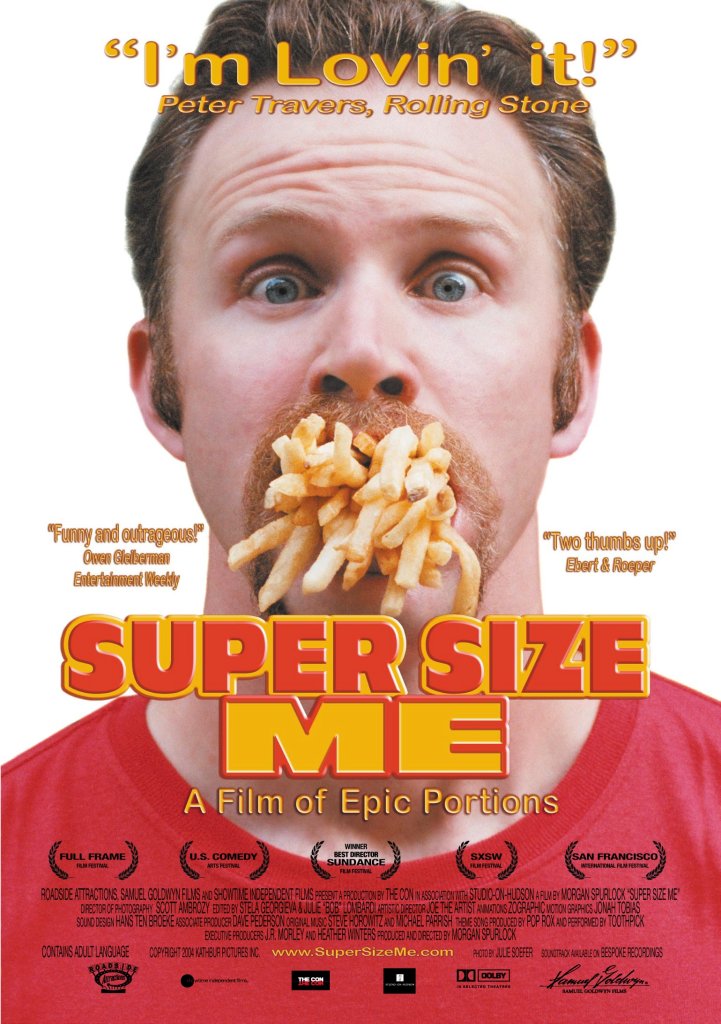
Morgan Spurlock’s documentary Super Size Me depicts this dangerous social experiment where Spurlock himself eats McDonald’s every day, for thirty days, three times a day. If McDonald’s doesn’t sell it, Spurlock cannot have it. Within the first day of ingesting his first “Super Sized” meal of the experiment, Spurlock gets extremely sick and throws up everything. After bringing doctors, food workers, pedestrians, and coworkers into this narrative, he was able to uncover the depths of the fast-food industry as well as the negative physical and emotional effects of fast food. Super Size Me is full of information from experts such as doctors and nutritionists who are either surveyed or contributing their knowledge in the medical field and translating these results of fast food on Spurlock’s body.
Food becomes more than just something we eat to survive, it becomes a toxic, lethal little devil on your shoulder when injected with fat and sugar and advertised as a happy, delicious meal that either comes with a toy or old childhood feelings of rewarding fun. Food is characterized as a maniacal tool used to create addicts who feel the need to get a fix, which in this case is the salt, sugar, and carbohydrates. But it’s also characterized as a comforting friend when he finds that his mood improves only when he eats. At one point Spurlock’s girlfriend compared this food to heroin. Spurlock denies this comparison that heroin and McDonalds, but then speaks to a doctor who discloses that it’s psychologically addicting. Neal Barnard, MD is part of the Physicians Committee for Responsible Medicine, discusses the use of naloxone to reverse the effects of heroin and prevents a person from overdosing. This same agent can be injected into a person, non-stop eating chocolate, who will then put it down and feel no need to continue eating the chocolate. This drug blocks the opioid receptors in the brain in order to halt the effects of heroin and the same goes for food. This is sheer proof that food can be treated just as drugs are. Of course there are certain boundaries drugs and foods have, but both can be coveted sources of good feelings of reward.
Advertising manipulates children to urge their parents to buy food that seems fun and more than just satisfying. “Brand printing for later actuation in life” was studied by a tobacco company, according to John F. Banzhaf III, a law professor at George Washington University. He says that people who would play with and have the candy cigarettes would go to smoke when they’re older because they’re connecting those good feelings from childhood with now real cigarettes. Banzhaf acknowledges that McDonald’s does the say thing with their warm food, fun environment, and rewarding toys.
By the end of this documentary, Spurlock suffers from lethargy, chest pain/ tightness, weight gain, an increase in cholesterol, a fat liver, and even erectile dysfunction. Over the course of a month of eating just McDonald’s, he was able to gain 24.5 pounds. Thankfully, he went on a vegan diet and after a few months was able to get his body functioning as it had been before this lethal experiment. What’s great about this documentary is that they also cover fast food in schools and how students in correctional schools were eating better than students in public schools for the same price. They also mentioned how everything has been McDonaldized and created to be fast, efficient, and gratifying at the end of the day. We have grown accustomed to this lifestyle that promotes obesity, heart disease, and health issues among the many.
Karen Palmer talks about her traumatic experience escaping a marriage in a portion of a memoir called, The Reader Is the Protagonist. After recovering her daughter from her ex-husband and then leaving him for another man, Palmer seeks refuge in Boulder, Colorado with her new family and their newer identities. Starting this new life meant cutting off past relationships with friends and family while also being able to find a new normal with her two daughters and new husband.
Eventually, she reveals the story of how her husband murdered an alleged rapist because the judicial system failed him and he decided to take matters into his own hands. This story arrives towards the end of a fight they were already having and Palmer feels the need to run away from him out of fear. Her ex-husband says, “Like tossing a piece of trash. No one saw. No one knew. No one ever even missed him” (Palmer 198). Her ex thought of himself as a “hero” according to Palmer and this delusional retelling of a threatening story tells more about their entire relationship than an entire recount of their relationship. Words are very important to Palmer. Her mother relied on books as an escape from her distant and physically absent husband. Palmer learned to do the same, admiring the words in their rows as “heartbeats” and “the pages, turning, fluttered like wings” (Palmer 193). However, this childhood led her not only to adore books but eager “for a man’s words” who in this case spoke of a difficult upbringing, his experience in the army, and some illegal jobs he carried out.
While searching for a job in the newspaper, she comes across an independent publisher looking for a proofreader. She learns this company is Paladin Press, the publisher of Hit Man: A Technical Manual for Independent Contractors. They end up being sued for aiding and abetting when an actual hitman uses this guide to almost successfully get away with murder. Palmer is split about this Paladin settlement because she says that if you really do love words, you’d fight for free speech. However, due to her past, supporting Paladin seems wrong because “words can be dangerous; one way or another, there are always consequences” (Palmer 200).
After further research, there is much unknown about Karen Palmer probably because we don’t know her original name. She relocated back to California, so we can assume there is no longer the lingering threat of her ex-husband anymore.
Questions:
The conversation continues on Jessica’s blog.
Language is essential in all aspects of our lives. We use it every day to communicate with our family members, friends, classmates, coworkers, acquaintances, and strangers. Educational institutions of all types across America, for the most part, teach Standard English to their students. I saw absolutely nothing wrong with this until my professor for my Writing Against Oppression class in college began teaching us about the multitude of English dialects and the oppression of those who didn’t speak Standard English. In order to understand this issue of how our culture in America values Standard English, restricting any other forms to be introduced in the classroom, we must open up this conversation and dig into the history of education, observe evidence of how institutions who have oppressed minorities through education, and speak to various professors and students who have an insight on this subject more than I do.
Hi, I’m Christina, a college senior majoring in journalism with a minor in writing studies who feels especially offended that she wasn’t taught this subject or made aware of this issue considering the blatant racism there is in most educational institutions to this DAY.
Just to give a little background into my own past and upbringing really quickly; I’m a 22-year-old student from Staten Island, NY. My mother’s side of the family is Filipino and my dad’s side is Italian. I grew up going to public school all of my life until high school where I went to a private, Catholic, predominantly white high school. We recited a mission statement every morning, prayed in Latin, had nuns, a convent on campus, ethics of religion classes (oof), and basically just the whole Catholic experience. Everyone who attended my school, including myself, was privileged. I was one of the few in a handful of people of color in my tiny graduating class of a hundred something students and I’m only half Filipino.
Anyways, I had to take speech classes as a child because my mother was afraid that I would be pronouncing words incorrectly and look/ sound uneducated. A speech pathologist would give me scented stickers and stamps to reward my construction and pronunciation of words in an overpriced, 30-minute session. It’s not that I had any “slang” terms popping out of my mouth at a young age, it was the pronunciation my mother paid so much money to fix. **insert sound byte of my mother on why she sent me to speech**
However, this concern for being afraid of how your child speaks and is perceived by the world is a concern for tons of people of color because of how the American school system has trained us to look down on those who don’t speak quote on quote, correctly. Who’s to say what is correct or not when schools here were originally founded by white people who colonized America. We can look back at Zitkala-Sa’s work titled American Indian Stories that illustrate her experience at the Carlisle School established by a Richard Henry Pratt who had the amazing idea to strip Native American students of their cultural identity both physically and emotionally through education.
**insert sound byte of expert/ professor on this history**
Jamila Lysicott is an assistant Professor of Social Justice Education at the University of Massachusetts Amherst and a Senior Research Fellow of Teachers College, Columbia University’s Institute for Urban and Minority Education (IUME).
**insert sound byte** 07:55- 08:38 from TED talk: Why English Class is Silencing Students of Color
The sense of fugitivity she mentions shouldn’t exist when a student speaks their “home” language at school.
**insert sound byte** 09:02- 09:23 from TED talk: Why English Class is Silencing Students of Color
This erasure was especially apparent in Zitkala-Sa’s experiences and unfortunately continues today.
TKE TKE TKE

Jad and Robert Krulwich essentially tell the story of where typhoid originated and how it began to spread. The theme of the Radiolab podcast, Patient Zero, is how diseases like typhoid and HIV and AIDS began. By investigating and speaking to experts, they were able to piece together a narrative that illustrates the origins of the mentioned diseases.
At the beginning of the podcast, the two hosts actually visit the island where “Typhoid Mary” was contained because she was not allowed to cook for society any longer. She would make peach ice cream for families and this lead to the spread. They describe how creepy the place seemed and this added to the description. She would test positive some times and then negative for others. Since no one knew when she would be infectious, they kept her locked up in quarantine. You begin to wonder how many more people were infected and how so if she was locked up. It turns out she was cooking after being legally banned from doing so for other people. They were able to transition to the AIDS epidemic and how they found patient zero in this case. I particularly liked how they introduced scientists and other experts to add more input and credibility. A technique they used that I would steal would be how the experts would answer a question and then get introduced by the host instead of abruptly introducing the scientists.
In order to structure this podcast, I’m sure they asked where HIV originated and then what correlation do monkeys, chimps and gorillas have with it. They would also ask what was the moment of “spillover” and how did they only find out about this in the ‘80s if it’s been around for so long.
I’m going to explore the topic of Student’s Rights to Their Own Language. I want to explore past news articles, TED Talks, interviews with educators, individuals who just became educators, and students themselves on the subject. I am studying this subject in my Writing Against Oppression class. I am inspired by this subject because this is an issue that affects a lot of students. I want to explore why and when such standards were put into place, if they’re fair, how the organization seeks to change them, and what this means for future students and educators.
Today I attended an event title Digital Nonfiction: Composing Identities In and Beyond the Classroom. Londie Martin, an assistant professor at the University of Arkansas at Little Rock, held a 70-minute interactive workshop and taught us how to mold our ideas for a nonfiction narrative. She taught us concepts from creative nonfiction that digital nonfiction uses such as a present author, self-reflection, research, and a flexible form. We discovered sensory expression, representation, non/linearity, and interactivity with objects that meant a lot to us.
Professor Martin gave us prompts to round out our stories and I chose the one where I reconsidered the authority of someone central to my life. I chose the gold necklace my father gave me that made me finally feel included along with my brothers. My brothers had theirs for years before I got my own. It seemed as though it were a prize of medal for being the best sons. Then I realized, I don’t need his approval or recognition considering everything he believes in and the way he disciplined me growing up was abuse, verbal and physical.
Professor Martin also showed us ways in which students formed their digital nonfiction narratives through an interactive desktop on a platform. One student created a narrative through objects depicted in a room that meant a lot to her. We clicked on a home icon and it revealed a text where she displayed her feelings of being an adopted child and resenting her family’s history that “wasn’t hers.” I look forward to discovering new ways to publish my own narratives online.
For our podcast project, I might tackle argument being had inside of my grandmother’s home. As mentioned in my essay Raising Your Husband, my grandmother has to put up with a lot when it comes to my grandfather’s daily needs. From being fed to being changed, she does it all. Her reasoning is that he will feel home-sick if he’s put into a nursing home. She would “hate to just put him away” into assisted living and I want to know what both arguments have to say. I want to interview people who have put their own parents or grandparents in a nursing home. I would like to find out why they either did or did not put their loved one in a nursing home, where along the timeline of their illnesses and age did they decide this was the option if they did choose it, and what types of homes there are. I want to find out at what point are in-home nurses not enough and whether or not it is even ethical at all to put a loved on into a nursing home. Does it mean you don’t love them? Does it mean you’re giving them a chance to be cared for beyond your own abilities? Or does it mean you are doing the best that you can to improve their quality of life?

Every day, my grandmother has to fall in love with a new person. She wakes up with zero expectations of how to communicate with this new person, how to pacify this new person, and how to cater to this new person she didn’t choose to marry. Originally, Jean fell in love with Tony Petruzzi after only 4 months. Only a month into her marriage, she got pregnant with her first-born and was thrown into motherhood unexpectedly. She had another child and assumed the role of a full-time mother. Daily tasks included cooking for the children, cleaning up after their messes, tying their shoes, and making sure they didn’t leave the house without her authority.
Today, nearly 60 years later, she is doing the same thing for her husband. Her husband’s brain cells are dying every day and it’s like raising a child all over again. The only caveat is, he cannot learn. A child would learn after a few lessons on how to tie their shoes, wipe their face, and use the bathroom. As one would potty-train their child, he has to be helped in the bathroom, wearing a diaper at all times, but will never know how to use a toilet properly again. He can no longer do any of those without any help. This degenerative brain disease “destroys neurons and their connections in parts of the brain involved in memory…” (nia.nih.gov). It doesn’t just destroy neurons and their connections for the family, but a person’s entire identity, love, and passion for their life they lived until they couldn’t anymore.
More morbidly, this brain disease resonates with the image of a parasite wiggling through the grooves of the brain finding every opportunity to ruin the man who used to be. Even though there is no such thing medically involved with this disease, I see this foreigner attacking my grandpa’s brain making him curse horrible words at my grandmother, bruise her arms, argue in circles without a solution, and forget the moments he can no longer cherish. She has to raise her husband all over again only for this parasite to degrade her actions and make her feel like every task goes undone. Closing a door only for a stranger to open it again, feeding that same stranger only for them to spit out their food, changing a stranger’s diaper only for them to dirty it, again and again, every day.
Moments of clarity are no longer available. He is only able to recognize his wife, the last leg he is able to stand on mentally. Once, a few months ago, before the channel on the T.V. finally closed and the static finally turned to black, he stared at me and said, “I know I’ve lived here a long time, and I know who I am, but…” He didn’t finish his sentence, but I couldn’t help but feel like the parasite couldn’t find a crevice to reside in and my grandpa was able to speak to me one last time. I wonder if he was going to tell me he didn’t know what was wrong with him. Or if he knew that he had Alzheimer’s at all. Now, we are flooded with the same stories, mannerisms, and habits only my grandmother knows how to tend to.
His stories, which he retells with great passion and vulgar language can be described as a reflection of a real moment that his ego enhances to pose him as the victor in the end. A subtle discrepancy can be amplified into a violent fight with six men on the beach whom he beat up and sent to the hospital. He tells these stories from the comfort of his worn, brown, leather armchair, sitting in what’s left of his muscles that have worn away and his bones that protrude through his clothes.
Anger and violence are not the only emotions and qualities he still possesses. He still has child-like moments where he makes duck noises or wiggles his ears to amuse guests, things he would do for us as children to get a laugh. He still gushes over how beautiful his wife is who keeps a smile that he still gets to treasure every day. Home is the only place he recognizes, which is probably why he always wants to stay there and never wants to leave that warn out armchair. It’s so beautiful that even in his confused state, he can still recognize a place that he is able to identify with safety, love, and comfort. As much as I would love for him to feel this way for the remainder of his life, he needs more than his wife raising him every day.
She too is worn and tired. She is only a year younger than he is, 88. With some help from nurses, she manages but refuses to put him in an assisted living care facility. Hence, her bruised arms. Her sons have worked hard enough in life to live with more than just comfort, so there is no financial burden for her to worry about if it really came down to it. She compromises the quality of her own life for that of her husband, who is no longer her husband.
His heart is extremely healthy. According to doctors, it’s a lot healthier than one would expect from a man of his age. They say his heart won’t be the thing that kills him, but this disease will cause his body to slowly forget how to function.

As a journalism student, this task of creating a personal memoir was extremely daunting. I felt as though my brain has been trained to only relay hard facts and that I wouldn’t be able to find a subject to discuss in a more intimate and personable context. It turns out personal essays require the essential questions to be answered similar to journalism. Lopate says, “In this sense, the personal essayist must be like a journalist, who respects the obligation to get in the basic orienting facts— the who, what where, when, and why— as close to the top of every story as possible.”
For this personal memoir, I decided to explore my grandfather who was born in the Philippines and came to America to become a doctor. From a first-person perspective, I will be exploring this multi-faceted family member with whom I share many memories. He had so many layers and now after analyzing my memories with him, I have so many questions to ask. The story of my Papa Seb would appeal to readers because he was a complex character who faced significant loss at a young age, lived through poverty, caught food for his family as a child, and moved to the states to pursue medicine. He taught me so much through words and silence. He spoke a lot more before he started battling cancer, which was a long, drawn-out process he only continued to pursue because of his family. I look forward to exploring the depths of my memory and possibly solving a few missing pieces.

 Christina's WSC 110 Blog