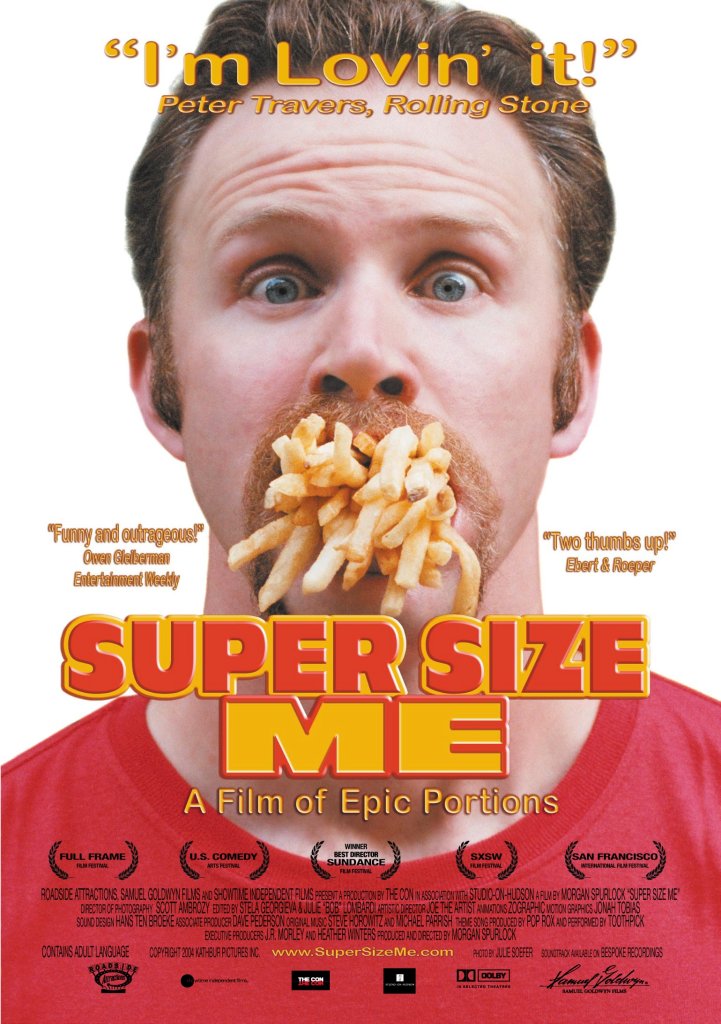
Morgan Spurlock’s documentary Super Size Me depicts this dangerous social experiment where Spurlock himself eats McDonald’s every day, for thirty days, three times a day. If McDonald’s doesn’t sell it, Spurlock cannot have it. Within the first day of ingesting his first “Super Sized” meal of the experiment, Spurlock gets extremely sick and throws up everything. After bringing doctors, food workers, pedestrians, and coworkers into this narrative, he was able to uncover the depths of the fast-food industry as well as the negative physical and emotional effects of fast food. Super Size Me is full of information from experts such as doctors and nutritionists who are either surveyed or contributing their knowledge in the medical field and translating these results of fast food on Spurlock’s body.
Food becomes more than just something we eat to survive, it becomes a toxic, lethal little devil on your shoulder when injected with fat and sugar and advertised as a happy, delicious meal that either comes with a toy or old childhood feelings of rewarding fun. Food is characterized as a maniacal tool used to create addicts who feel the need to get a fix, which in this case is the salt, sugar, and carbohydrates. But it’s also characterized as a comforting friend when he finds that his mood improves only when he eats. At one point Spurlock’s girlfriend compared this food to heroin. Spurlock denies this comparison that heroin and McDonalds, but then speaks to a doctor who discloses that it’s psychologically addicting. Neal Barnard, MD is part of the Physicians Committee for Responsible Medicine, discusses the use of naloxone to reverse the effects of heroin and prevents a person from overdosing. This same agent can be injected into a person, non-stop eating chocolate, who will then put it down and feel no need to continue eating the chocolate. This drug blocks the opioid receptors in the brain in order to halt the effects of heroin and the same goes for food. This is sheer proof that food can be treated just as drugs are. Of course there are certain boundaries drugs and foods have, but both can be coveted sources of good feelings of reward.
Advertising manipulates children to urge their parents to buy food that seems fun and more than just satisfying. “Brand printing for later actuation in life” was studied by a tobacco company, according to John F. Banzhaf III, a law professor at George Washington University. He says that people who would play with and have the candy cigarettes would go to smoke when they’re older because they’re connecting those good feelings from childhood with now real cigarettes. Banzhaf acknowledges that McDonald’s does the say thing with their warm food, fun environment, and rewarding toys.
By the end of this documentary, Spurlock suffers from lethargy, chest pain/ tightness, weight gain, an increase in cholesterol, a fat liver, and even erectile dysfunction. Over the course of a month of eating just McDonald’s, he was able to gain 24.5 pounds. Thankfully, he went on a vegan diet and after a few months was able to get his body functioning as it had been before this lethal experiment. What’s great about this documentary is that they also cover fast food in schools and how students in correctional schools were eating better than students in public schools for the same price. They also mentioned how everything has been McDonaldized and created to be fast, efficient, and gratifying at the end of the day. We have grown accustomed to this lifestyle that promotes obesity, heart disease, and health issues among the many.
 Christina's WSC 110 Blog